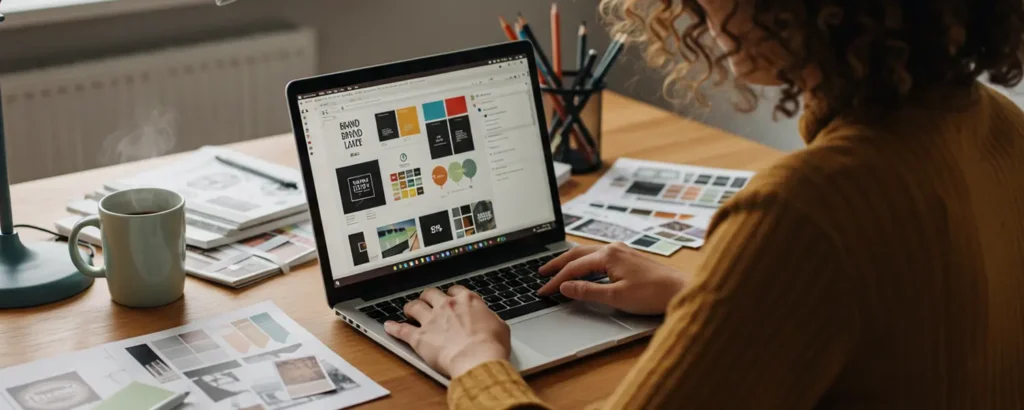


AI now shapes almost every corner of the design world. It drafts ideas, builds images, writes scripts, and produces brand directions at a pace that seemed impossible only a few years ago. This acceleration has created a new challenge for designers and creative teams. We now work in an environment where polished content appears constantly, and much of it looks convincing enough to pass as genuine. When everything looks real, trust becomes a more valuable resource than ever.
Over the past year, we’ve seen this shift across client work, community projects, and early-stage brand development. Small businesses feel unsure about what they’re seeing online. Founders worry their brand might be mistaken for AI-made content. Designers question how much influence AI should have on their craft. These discussions are becoming more common, and they push us to think carefully about how we present work, communicate process, and maintain authenticity.
Openness Helps People Understand the Creative Journey
Designers once focused primarily on presenting polished final deliverables. That approach doesn’t hold up as well today. People respond better when they see the thinking behind the work. They want to understand how ideas formed, not just what the end product looks like.
When we share rough sketches, early layouts, or unpolished explorations, clients feel more grounded in the process. On a recent branding project for a small café, the owner said that seeing loose pencil layouts made the work feel more trustworthy. They could follow the thinking and see that nothing was recycled or artificially generated. That sense of transparency builds confidence in a way that a polished deck alone cannot.
We’ve seen the same response in community projects. When shaping updates for LoveHilton.co.uk, showing the earliest directions helped the group understand why certain choices worked. They saw the reasoning, not just the final artwork. The journey became part of the value.
Keeping Our Voice at the Centre of AI-Assisted Work
AI brings speed and variety, but it doesn’t bring judgement or perspective. That distinction matters. Designers who stand out today use AI to explore early directions but rely on their own experience to shape the final outcome.
AI helps us move quickly through early ideation. It helps test visual territories, gather references, and break past creative blocks. But once we enter the refinement stage, human thinking becomes essential. We set hierarchy, structure, rhythm, and purpose. These elements create meaning, and AI cannot replace that.
Founders often spot the difference immediately. AI-led work looks accurate but feels emotionally hollow. Human-led work carries intention they can understand. This pattern appears repeatedly and reinforces why our voice still matters.
Human Details Make Work Feel Grounded
As AI becomes better at producing realistic visuals, small human touches stand out more. These elements remind people that the work comes from lived experience rather than prediction.
Real photography captures familiar places in a way synthetic imagery cannot. Handwritten notes in a concept deck make the work feel closer. Slight irregularities in a drawing or layout help people feel a human presence behind the decisions.
When updating LoveHilton.co.uk, we used photographs shared by local residents. The impact was immediate. People recognised their own streets, buildings, and surroundings. AI-generated scenes might have looked neater, but they lacked the sense of belonging that mattered to the community.
This trend tells us that authenticity becomes a design advantage when AI competes on polish.
Protecting Work When Imitation Is Easy
AI can mimic styles quickly if someone feeds it enough examples. This makes authorship more fragile. Designers are responding by adding subtle layers of protection to their work.
Some use metadata in exported files. Others keep watermarks on early drafts. Many document their process carefully to help clients understand what is original and what is assisted. One founder we worked with discovered early concepts circulating online before launch. The only way to prove ownership was through hidden metadata in the original files.
These measures aren’t about restriction. They help maintain clarity in a world where copying is often effortless and unintentional. They also reassure clients that the work created for them is uniquely theirs.
Giving Users Clear Context When AI Is Part of the Product
When we design digital tools that include AI, clarity becomes essential. Users want to know what the system does with their input. They want to know how the output is shaped. They want to understand what is automated and what is guided.
During testing for a small platform prototype, the first question users asked wasn’t about features. It was about trust. They wanted to know what the AI would do with their information and how much influence it had over the results. Once that was explained clearly, engagement increased and hesitation dropped.
This behaviour shows how important it is to set expectations early. When people know the rules, they feel more confident using the product.
Real Feedback Reveals Whether the Work Feels Honest
AI can give us endless variations, but only real people can tell us whether something feels believable. Small user tests reveal doubt faster than any automated tool. They show where clarity is missing or where something feels “too generated.”
When we sit with users and watch them interact with a layout, a prototype, or a brand direction, we see the moments of hesitation. We hear questions about authenticity. We confirm which parts feel genuine and which parts feel artificial. These insights guide decisions far more effectively than producing hundreds of new variations.
The teams that embrace regular feedback create work that stays human, even when AI has shaped part of the process.
Final Thoughts
AI has transformed design, but it hasn’t replaced the need for human judgement. Our perspective, our decisions, and our clarity are what make the work believable. When we show our process openly, keep our voice at the centre, and design with intention, the work builds trust in an environment where uncertainty is common.